From sugar to wrapper
How a Sugarwren lollipop gets made
Eight steps, one marble slab, and about four hours from the first boil to the last twist of parchment. Nothing about this is efficient. That is roughly the point.
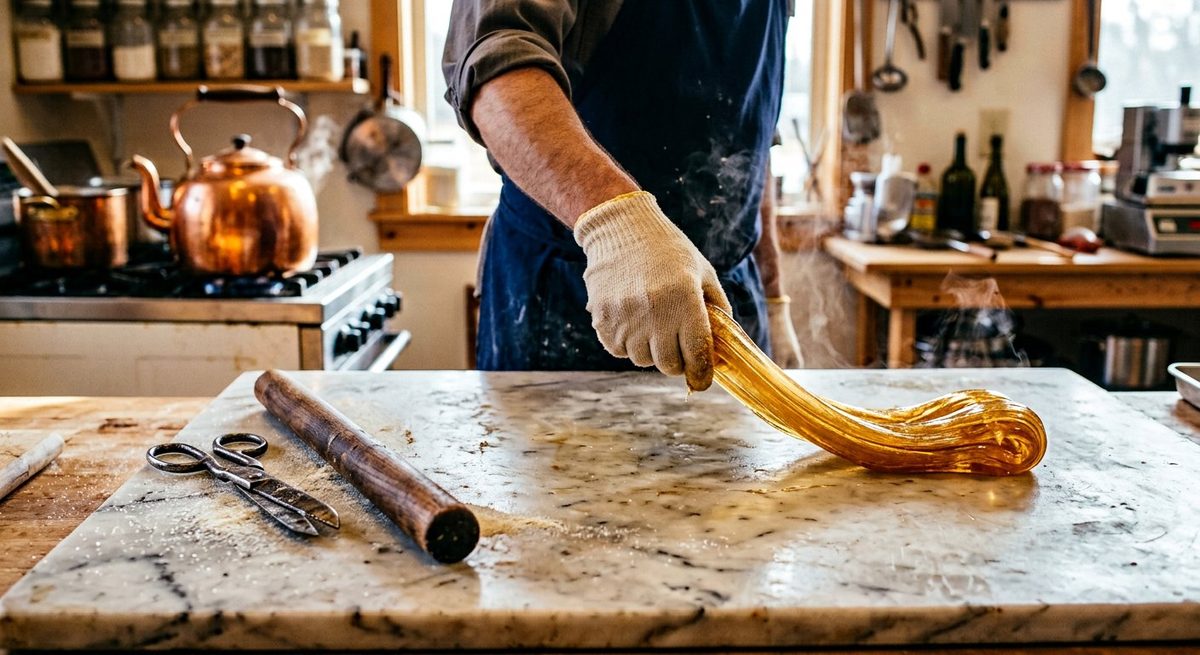
1. Weigh, then boil
Every batch starts on a scale, never by eye. Sugar, water and a glucose syrup go into the copper pot and come up to a hard crack — the stage where a drop of syrup in cold water sets into threads that snap. We cook by temperature and by feel together, because a thermometer tells you where you are and the smell of the pot tells you whether you have gone too far.
2. Colour and flavour, off the heat
Colour goes in the moment the pot leaves the burner, folded through with a wooden paddle. Flavour goes in a few seconds later, when the syrup has dropped a little — essential oils and fruit acids are volatile and will simply leave if you add them while it is still angry. This is the step where a batch is won or lost, and it is over in under a minute.
3. Onto the marble
The syrup is poured onto a cool marble slab and worked with paddles, turning the outside in, until it is cool enough to handle and even enough in colour to stretch. Our slab is a century-old piece of stone from a bakery that closed in Bloomington; it holds temperature the way cast iron holds heat.
4. Pulling and folding
This is the part people mean when they say hand-pulled. The mass is stretched, folded back on itself, twisted and stretched again — dozens of times. Each fold traps a film of air between layers of sugar. Those layers are what make the candy look like it has depth and what makes it shatter cleanly instead of splintering into dusty shards.
5. Shaping
Round lollipops are formed by hand from a rope of sugar, weighed piece by piece. Prisms are cut with a warm blade on the slab. The lantern drops are pressed into a cast-aluminium mould bought at an estate sale in St. Paul. Sticks go in while the candy is still soft enough to grip.
6. Cooling and cracking
Pieces cool on parchment, undisturbed, for at least forty minutes. Sugar is a glass; if it cools too fast it builds internal stress and will crack in the box three days later. We lose more candy to impatience than to any other cause.
7. Wrapping by hand
Each piece is wrapped in parchment and twisted at the base, then labelled by hand with the candy name and the date. Wrapping is the least skilled job in the kitchen and the one that takes the longest. It is also the only moment we get to look at every single piece before it goes out.
8. The staff jar
Anything that clouds, cracks along a facet, or comes out a shade we did not intend goes into a jar by the door. Nothing imperfect is sold, and nothing imperfect is thrown away either. On a bad day the jar fills fast; on a good day it stays depressingly empty.
Sugar does not care how you feel about the weather. In July the kitchen wins; in January, we do.
What we don't do
- We don't use a machine to pull, roll or cut. Two people, a slab and a blade.
- We don't stock candy made last year. Boxes are dated by hand and we would rather sell out.
- We don't make medical or dietary claims about candy. It is a sweet, not a supplement.
- We don't publish ingredient lists on the site — but we will tell you, in detail, if you ask.
- We don't take payment through this website. Every order is confirmed by a person first.
Curious about the texture side of all this? There is a longer piece in the journal on why hand-pulled candy crunches differently, and a practical one on storing hard candy once it gets home.
Send us an order request
Tell us which candies caught your eye and how many you need. We reply by email within two business days with availability, price and pickup times.